Extended Ward
See also
Create Function
- pandapower.create.create_xward(net, bus, ps_mw, qs_mvar, pz_mw, qz_mvar, r_ohm, x_ohm, vm_pu, in_service=True, name=None, index=None, slack_weight=0.0, **kwargs)
Creates an extended ward equivalent.
A ward equivalent is a combination of an impedance load, a PQ load and as voltage source with an internal impedance.
- Parameters::
net: The pandapower net within the impedance should be created bus: bus of the ward equivalent ps_mw: active power of the PQ load qs_mvar: reactive power of the PQ load pz_mw: active power of the impedance load in MW at 1.pu voltage qz_mvar: reactive power of the impedance load in MVar at 1.pu voltage r_ohm: internal resistance of the voltage source x_ohm: internal reactance of the voltage source vm_pu: voltage magnitude at the additional PV-node slack_weight: Contribution factor for distributed slack power flow calculation (active power balancing)
- Returns:
the id of the created xward
- Parameters:
net (pandapowerNet)
bus (int | integer)
ps_mw (float)
qs_mvar (float)
pz_mw (float)
qz_mvar (float)
r_ohm (float)
x_ohm (float)
vm_pu (float)
in_service (bool)
name (str | None)
index (int | integer | None)
slack_weight (float)
Input Parameters
net.xward
Parameter |
Datatype |
Value Range |
Explanation |
name |
string |
name of the extended ward equivalent |
|
bus* |
integer |
index of connected bus |
|
ps_mw* |
float |
constant active power demand [MW] |
|
qs_mvar* |
float |
constant reactive power demand [MVar] |
|
pz_mw* |
float |
constant impedance active power demand at 1.0 pu [MW] |
|
qz_mvar* |
float |
constant impedance reactive power demand at 1.0 pu [MVar] |
|
r_ohm* |
float |
\(>\) 0 |
internal resistance of the voltage source [ohm] |
x_ohm* |
float |
\(>\) 0 |
internal reactance of the voltage source [ohm] |
vm_pu* |
float |
\(>\) 0 |
voltage source set point [p.u] |
in_service* |
boolean |
True / False |
specifies if the extended ward equivalent is in service. |
*necessary for executing a power flow calculation.
Electric Model
The extended ward equivalent is a ward equivalent: with additional PV-node with an internal resistance.
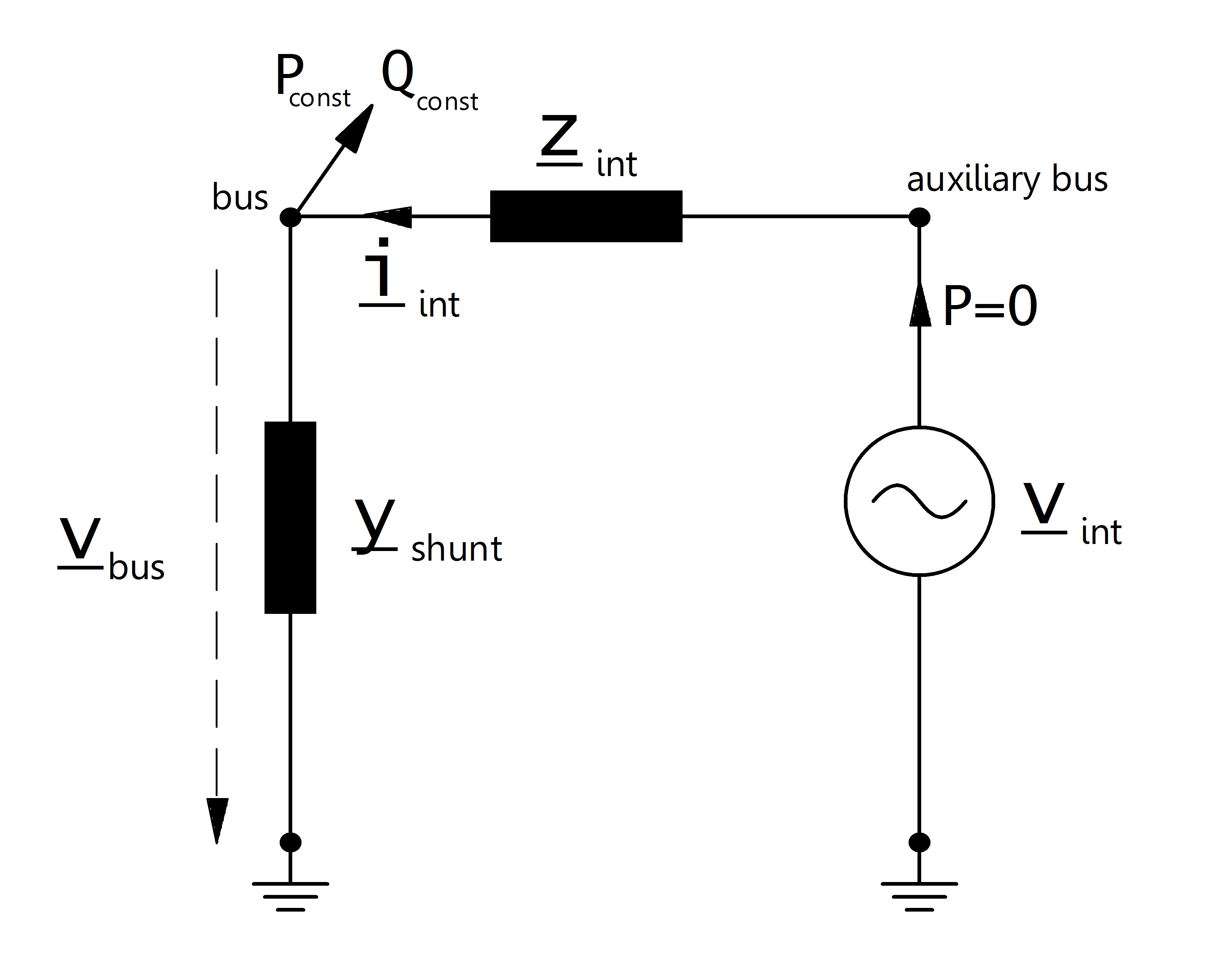
The constant apparent power is given by:
The shunt admittance part of the extended ward equivalent is calculated as described here:
The internal resistance is defined as:
The internal voltage source is modelled as a PV-node (generator) with:
Result Parameters
net.res_xward
Parameter |
Datatype |
Explanation |
p_mw |
float |
active power demand of the ward equivalent [MW] |
q_mvar |
float |
reactive power demand of the ward equivalent [MVar] |
vm_pu |
float |
voltage at the ward bus [p.u] |