Bus
See also
Create Function
- pandapower.create.create_bus(net, vn_kv, name=None, index=None, geodata=None, type='b', zone=None, in_service=True, max_vm_pu=nan, min_vm_pu=nan, coords=None, **kwargs)
Adds one bus in table net[“bus”].
Buses are the nodes of the network that all other elements connect to.
- Parameters:
net (pandapowerNet) – The pandapower network in which the element is created
vn_kv (float) – The grid voltage level.
name (str | None) – the name for this bus
index (int | integer | None) – Force a specified ID if it is available. If None, the index one higher than the highest already existing index is selected.
geodata (tuple[float, float] | None) – (x, y) tuple coordinates used for plotting
type (Literal['n', 'b', 'm']) – Type of the bus. “n” - node, “b” - busbar, “m” - muff
zone (str | None) – grid region
in_service (bool) – True for in_service or False for out of service
max_vm_pu (float) – Maximum bus voltage in p.u. - necessary for OPF
min_vm_pu (float) – Minimum bus voltage in p.u. - necessary for OPF
coords (list[tuple[float, float]] | None) – list (len=2) of tuples (len=2) busbar coordinates to plot the bus with multiple points. coords is typically a list of tuples (start and endpoint of the busbar) - Example: [(x1, y1), (x2, y2)]
- Returns:
The unique ID of the created element
- Return type:
int | integer
Example
>>> create_bus(net, 20., name="bus1")
- pandapower.create.create_buses(net, nr_buses, vn_kv, index=None, name=None, type='b', geodata=None, zone=None, in_service=True, max_vm_pu=nan, min_vm_pu=nan, coords=None, **kwargs)
Adds several buses in table net[“bus”] at once.
Buses are the nodal points of the network that all other elements connect to.
- Parameters:
net (pandapowerNet) – The pandapower network in which the element is created
nr_buses (int) – The number of buses that is created
vn_kv (float | Iterable[float]) – The grid voltage level.
name (Iterable[str] | None) – the name for this bus
index (int | integer | Iterable[int | integer] | None) – Force specified IDs if available. If None, the indices higher than the highest already existing index are selected.
geodata (tuple[float, float] | Iterable[tuple[float, float]] | None) – (x,y)-tuple or Iterable of (x, y)-tuples with length == nr_buses, coordinates used for plotting
type (Literal['n', 'b', 'm'] | ~typing.Iterable[~typing.Literal['n', 'b', 'm']]) – Type of the buses. “n” - auxiliary node, “b” - busbar, “m” - muff
zone (str | Iterable[str] | None) – grid region
in_service (bool | Iterable[bool]) – True for in_service or False for out of service
max_vm_pu (float | Iterable[float]) – necessary for OPF
min_vm_pu (float | Iterable[float]) – necessary for OPF
coords (list[list[tuple[float, float]]] | None) – busbar coordinates to plot the bus with multiple points. coords is typically a list of tuples (start and endpoint of the busbar) - Example for 3 buses: [[(x11, y11), (x12, y12)], [(x21, y21), (x22, y22)], [(x31, y31), (x32, y32)]]
- Returns:
The IDs of the created elements
- Return type:
ndarray[tuple[Any, …], dtype[int | integer]]
Input Parameters
net.bus
Parameter |
Datatype |
Value Range |
Explanation |
name |
string |
name of the bus |
|
vn_kv* |
float |
\(>\) 0 |
rated voltage of the bus [kV] |
type |
string |
naming conventions:
“n” - node
“b” - busbar
“m” - muff
|
type variable to classify buses |
zone |
string |
can be used to group buses, for example network groups / regions |
|
max_vm_pu** |
float |
\(>\) 0 |
Maximum voltage |
min_vm_pu** |
float |
\(>\) 0 |
Minimum voltage |
in_service* |
boolean |
True / False |
specifies if the bus is in service. |
geo |
string / object |
geojson.Point as object or string |
*necessary for executing a power flow calculation
**optimal power flow parameter
Note
Bus voltage limits can not be set for slack buses and will be ignored by the optimal power flow.
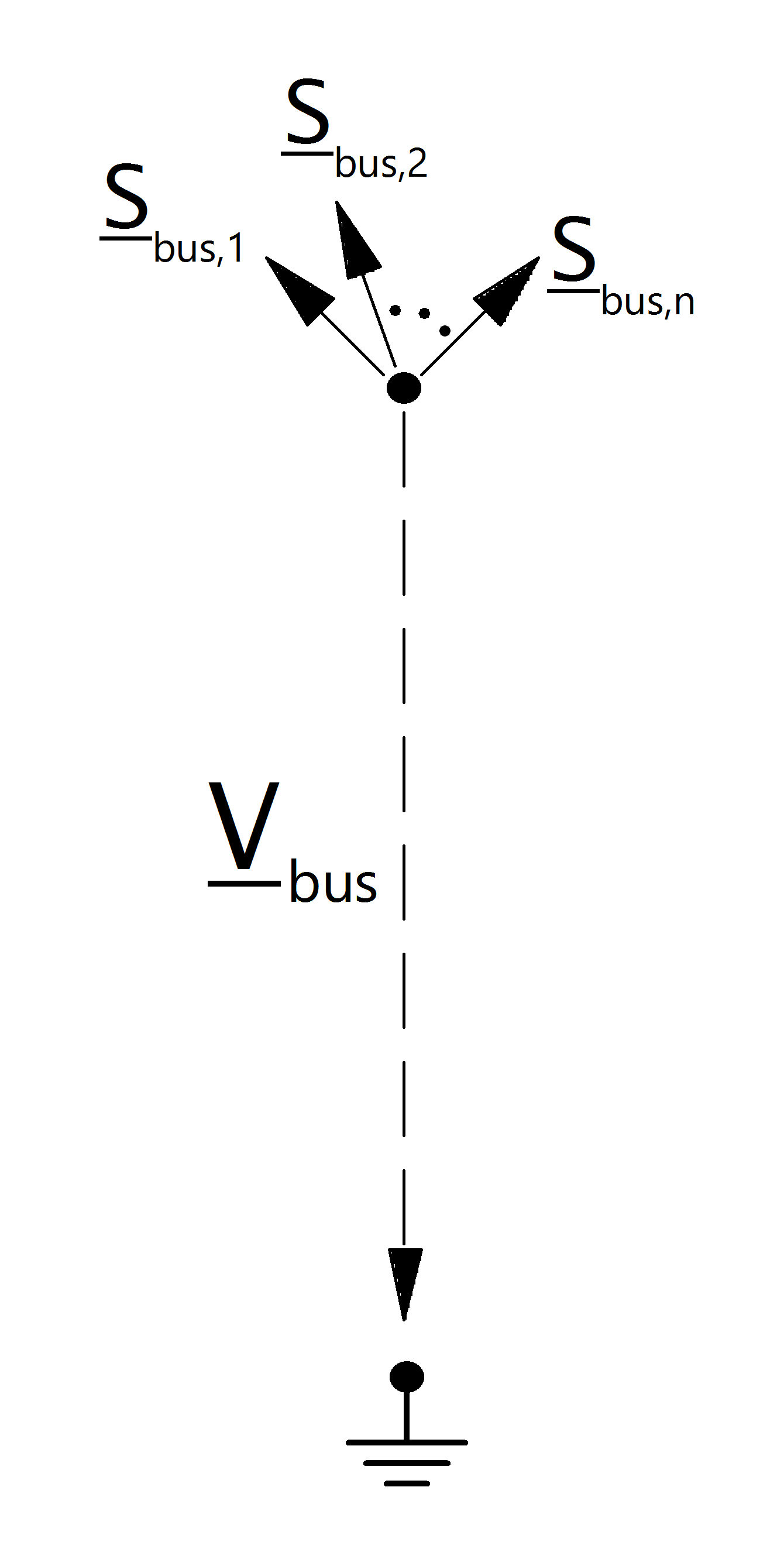
Electric Model
Result Parameters
net.res_bus
Parameter |
Datatype |
Explanation |
vm_pu |
float |
voltage magnitude [p.u] |
va_degree |
float |
voltage angle [degree] |
p_mw |
float |
resulting active power demand [MW] |
q_mvar |
float |
resulting reactive power demand [Mvar] |
The power flow bus results are defined as:
net.res_bus_3ph
Parameter |
Datatype |
Explanation |
vm_a_pu |
float |
voltage magnitude:Phase A [p.u] |
va_a_degree |
float |
voltage angle:Phase A [degree] |
vm_b_pu |
float |
voltage magnitude:Phase B [p.u] |
va_b_degree |
float |
voltage angle:Phase B [degree] |
vm_c_pu |
float |
voltage magnitude:Phase C [p.u] |
va_c_degree |
float |
voltage angle:Phase C [degree] |
p_a_mw |
float |
resulting active power demand:Phase A [MW] |
q_a_mvar |
float |
resulting reactive power demand:Phase A [Mvar] |
p_b_mw |
float |
resulting active power demand:Phase B [MW] |
q_b_mvar |
float |
resulting reactive power demand:Phase B [Mvar] |
p_c_mw |
float |
resulting active power demand:Phase C [MW] |
q_c_mvar |
float |
resulting reactive power demand:Phase C [Mvar] |
unbalance_percent |
float |
unbalance in percent defined as the ratio of V2 and V1 according to IEC 62749 |
The power flow bus results are defined as:
net.res_bus_est
The state estimation results are put into net.res_bus_est with the same definition as in net.res_bus.
Parameter |
Datatype |
Explanation |
vm_pu |
float |
voltage magnitude [p.u] |
va_degree |
float |
voltage angle [degree] |
p_mw |
float |
resulting active power demand [MW] |
q_mvar |
float |
resulting reactive power demand [Mvar] |
Note
Bus power values are given in the consumer system. Therefore a bus with positive p_mw value consumes power while a bus with negative active power supplies power.
net.res_bus_sc
The short-circuit (SC) results are put into net.res_bus_sc with following definitions:
Parameter |
Datatype |
Explanation |
ikss_ka |
float |
initial short-circuit current value [kA] |
skss_mw |
float |
initial short-circuit power [MW] |
ip_ka |
float |
peak value of the short-circuit current [kA] |
ith_ka |
float |
equivalent thermal short-circuit current [kA] |
rk_ohm |
float |
resistive part of equiv. (positive/negative sequence) SC impedance [Ohm] |
xk_ohm |
float |
reactive part of equiv. (positive/negative sequence) SC impedance [Ohm] |
rk0_ohm |
float |
resistive part of equiv. (zero sequence) SC impedance [Ohm] |
xk0_ohm |
float |
reactive part of equiv. (zero sequence) SC impedance [Ohm] |