Shunt
See also
Create Function
- pandapower.create.create_shunt(net, bus, q_mvar, p_mw=0.0, vn_kv=None, step=1, max_step=1, name=None, step_dependency_table=False, id_characteristic_table=None, in_service=True, index=None, **kwargs)
Creates a shunt element.
- Parameters:
**net** (pandapowerNet)
**bus** (int)
**p_mw** (float)
**q_mvar** (float)
**vn_kv** (float, None)
**step** (int, 1)
**max_step** (int, 1)
**name** (str, None)
**step_dependency_table** (boolean, False) - True if shunt parameters (p_mw, q_mvar)
**id_characteristic_table** (int, None)
**in_service** (boolean, True)
**index** (int, None)
net (pandapowerNet)
bus (int | integer)
q_mvar (float)
p_mw (float)
vn_kv (float | None)
step (int)
max_step (int)
name (str | None)
step_dependency_table (bool)
id_characteristic_table (int | None)
in_service (bool)
index (int | integer | None)
- Returns:
index (int) - the unique ID of the created shunt
- Return type:
int | integer
Example
create_shunt(net, 0, 20)
- pandapower.create.create_shunt_as_capacitor(net, bus, q_mvar, loss_factor, **kwargs)
Creates a shunt element representing a capacitor bank.
- Parameters:
**net** (pandapowerNet)
**bus** (int)
**q_mvar** (float)
**loss_factor** (float) - loss factor tan(delta)
create_shunt (same as in)
function (keyword arguments are passed to the create_shunt)
net (pandapowerNet)
bus (int | integer)
q_mvar (float)
loss_factor (float)
- Returns:
index (int) - the unique ID of the created shunt
- Return type:
int | integer
Input Parameters
net.shunt
Parameter |
Datatype |
Value Range |
Explanation |
name |
string |
name of the shunt |
|
bus* |
integer |
index of bus where the impedance starts |
|
p_mw* |
float |
\(\geq\) 0 |
shunt active power in MW at v= 1.0 p.u. per step |
q_mvar* |
float |
shunt reactive power in MVAr at v= 1.0 p.u. per step |
|
vn_kv* |
float |
\(>\) 0 |
rated voltage of the shunt element |
step* |
integer |
\(\geq\) 1 |
step position of the shunt with which power values are multiplied |
max_step* |
integer |
\(\geq\) 1 |
maximum allowed step of shunt |
in_service* |
boolean |
True / False |
specifies if the shunt is in service |
step_dependency_table |
boolean |
True / False |
whether the shunt parameters (q_mvar, p_mw) are adjusted dependent on the step of the shunt |
id_characteristic_table |
integer |
\(\geq\) 0 |
references the id_characteristic index from the shunt_characteristic_table |
*necessary for executing a power flow calculation.
Electric Model
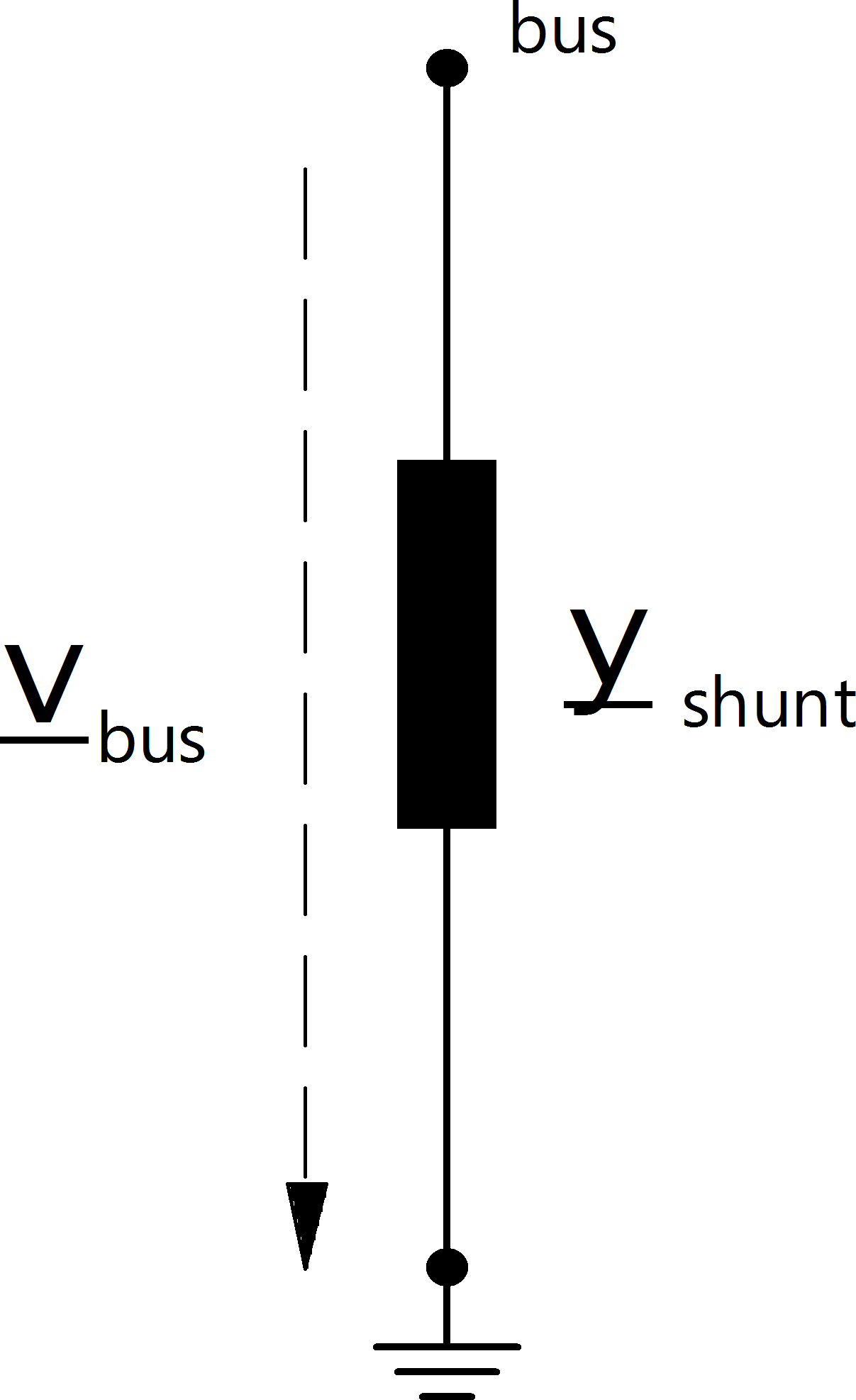
The power values are given at \(v = 1\) pu and are scaled linearly with the number of steps:
Since \(\underline{S}_{shunt, ref}\) is the apparent power at the nominal voltage, we know that:
Converting to the per unit system results in:
with the reference values for the per unit system as defined in Unit Systems and Conventions.
Shunt characteristic table
A shunt characteristic table (shunt_characteristic_table) can be used to adjust the shunt parameters (q_mvar, p_mw) according to the selected step position. This lookup table is created automatically from version 3.0 onwards through the CIM CGMES to pandapower converter (if this information is available in the EQ profile), or the user may define this table manually. The id_characteristic_table variable in net.shunt references the id_characteristic column in net.shunt_characteristic_table per shunt.
If the shunt_dependency_table variable in net.shunt is set to True, this indicates that there is a corresponding characteristic available in net.shunt_characteristic_table, which overwrites the default shunt parameters q_mvar and p_mw.
The below table provides an example shunt_characteristic_table, populated for two shunt elements.
id_characteristic |
step |
q_mvar |
p_mw |
|
0 |
0 |
1 |
176.3999987 |
0.223000955 |
1 |
0 |
2 |
171.0046573 |
0.223000955 |
2 |
0 |
3 |
165.6093266 |
0.223000955 |
3 |
0 |
4 |
160.2139746 |
0.223000955 |
4 |
0 |
5 |
155.4759927 |
0.223000955 |
5 |
1 |
1 |
179.999968 |
0.034992 |
6 |
1 |
2 |
174.083296 |
0.034992 |
7 |
1 |
3 |
168.166624 |
0.034992 |
8 |
1 |
4 |
162.249952 |
0.034992 |
9 |
1 |
5 |
156.333296 |
0.034992 |
Note
shunt_dependency_table has to be set to True and the id_characteristic_table variable needs to be populated in order to consider the corresponding shunt_characteristic_table values.
The function pandapower.control.shunt_characteristic_table_diagnostic can be used for sanity checks. The function pandapower.control.create_shunt_characteristic_object can be used to automatically create SplineCharacteristic objects and populate the net.shunt_characteristic_spline table according to the net.shunt_characteristic_table table. An additional column id_characteristic_spline is also created in net.shunt to set up the reference to the spline characteristics.
The below table provides an example shunt_characteristic_spline table, populated for two shunt elements.
id_characteristic |
q_mvar_characteristic |
p_mw_characteristic |
|
0 |
0 |
SplineCharacteristic |
SplineCharacteristic |
1 |
1 |
SplineCharacteristic |
SplineCharacteristic |
Result Parameters
net.res_shunt
Parameter |
Datatype |
Explanation |
p_mw |
float |
shunt active power consumption [MW] |
q_mvar |
float |
shunt reactive power consumption [MVAr] |
vm_pu |
float |
voltage magnitude at shunt bus [pu] |